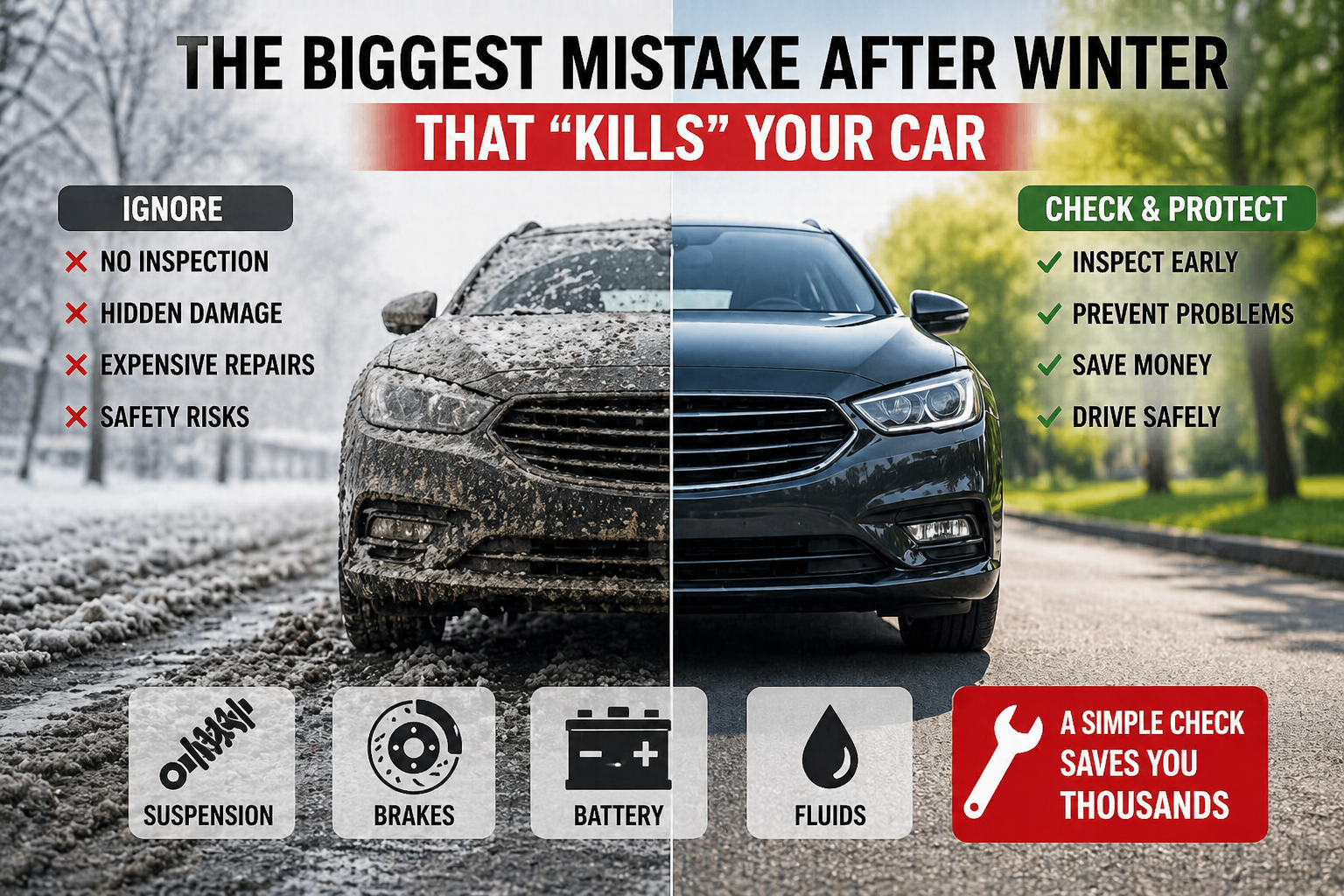
Why most car owners lose money after winter
After winter, your car still runs.
- engine starts
- brakes work
- no warning lights
So you skip inspection.
That decision is where money starts leaking.
Because winter damage doesn’t disappear.
It stays hidden — and grows.
What winter really does to your car
Winter is not just cold weather.
It’s a combination of stress factors:
- cold starts increase engine wear by 2–3×
- road salt accelerates corrosion several times
- potholes overload suspension components
- moisture affects wiring and sensors
Nothing breaks instantly.
Instead, your car builds internal wear you don’t see yet.
Why problems appear in spring
Spring doesn’t damage your car.
It exposes it.
As temperatures rise:
- rubber softens → cracks open
- metal expands → weak parts fail
- fluids thin → leaks appear
- battery stabilizes → weak cells die
This is why many drivers say:
“It was fine in winter.”
It wasn’t.
You just didn’t see it yet.
The 1 mistake after winter
Continuing to drive without inspection
Same speed.
Same braking.
Same habits.
But your car is already worn.
This mismatch turns:
small issues → expensive repairs
Suspension problems after winter (what to check first)
What actually happens
Winter causes:
- micro-cracks in bushings
- reduced shock absorber efficiency
- stress damage in joints
Early symptoms
- knocking over bumps
- steering feels less precise
- car drifts slightly
Real cost difference
- early repair: $50–100
- delayed repair: $300–700+
Quick self-check (30 seconds)
- drive slowly over bumps
- release steering wheel briefly
If the car feels unstable → check suspension immediately.
Brake problems most drivers ignore
After winter:
- brake discs start corroding
- pads wear unevenly
- brake fluid absorbs moisture
Why it’s dangerous
At 60 km/h:
- normal stop: ~36 m
- worn system: +3–7 meters
That distance can decide everything.
Simple test
Brake smoothly:
- vibration → warped discs
- noise → worn pads
- uneven braking → system issue
Battery problems after cold weather
Real numbers
At −10°C:
- battery loses 30–40% efficiency
After winter:
- it rarely returns to full strength
Why this matters
Battery failure happens suddenly.
Typical situation:
- everything works
- temperature drops slightly
- car doesn’t start
Fluids you must not ignore
Engine oil
- contaminated after winter
- protects less
- increases engine wear
Brake fluid
- absorbs water
- reduces braking performance
Coolant
- loses efficiency
- increases overheating risk
Key rule
Fluids don’t fail instantly.
They become less effective every day.
Underbody corrosion — the hidden cost
Salt doesn’t disappear.
It stays active even on dry roads.
What it causes
- rust on structural parts
- exhaust system damage
- weakened mounting points
Cost reality
- underbody wash: $20
- corrosion repair: $500–1000+
Driving mistakes that make everything worse
After winter, drivers switch too fast:
- aggressive acceleration
- hard braking
- higher speed
Problem
- roads are still damaged
- car is already weakened
Result
Wear increases 2–3× faster
Real chain reaction (why small problems explode)
- worn bushing
→ wheel misalignment
→ tire wear (~$400)
→ reduced grip
→ unsafe driving
One ignored part = multiple problems.
Real case from a workshop
Car: mid-size sedan
Mileage: 120,000 km
Driver skipped inspection.
After 2 months:
- suspension repair
- brake disc replacement
- battery failure
Total cost:
~$1,200
Preventive service:
~$250
What you can check yourself in 5 minutes
- look at brake discs (rust?)
- listen for suspension noise
- check steering alignment
- test braking feel
- observe cold start
If something feels different — it is.
When you must go to a mechanic
Go immediately if you notice:
- new noises
- vibration
- braking changes
- uneven tire wear
- fluid leaks
Delaying here – higher cost later.
Minimal spring car maintenance checklist
- change engine oil
- inspect brakes
- check suspension
- test battery
- wash underbody
Covers ~80% of risks.
Advanced maintenance (best option)
- full diagnostics
- wheel alignment
- full fluid replacement
- anti-corrosion treatment
Common myths
“No warning lights = no problem”
Wrong — many issues are mechanical.
“I’ll fix it later”
Later = more expensive.
“Reliable cars don’t need checks”
Every car wears.
How to think like a mechanic
Don’t ask:
“Is my car broken?”
Ask:
“What is already wearing out?”
The truth most drivers ignore
Cars don’t fail suddenly.
They:
- wear
- signal
- degrade
Then they fail.
Final conclusion
The biggest mistake after winter is simple:
doing nothing.
What actually saves your money
- early inspection
- small repairs on time
- smoother driving in spring
- attention to details
Final takeaway
Spring maintenance is not an expense.
It’s the cheapest way to avoid expensive repairs.
Ignore it —
and your car will remind you.
With a bill.