Modern cars are becoming smarter every year. Drivers already use parking cameras, lane assist systems, automatic braking, and adaptive cruise control in daily life. Now, Ford is exploring another important area of vehicle safety: protecting parked cars from accidents before they happen.
The company recently patented a new technology designed to help parked vehicles detect danger, warn nearby people, and even move away from possible collisions. The system could protect cars from careless drivers, uncontrolled shopping carts, slippery parking lots, and other common risks.
Although the technology is still at the patent stage, the idea has already attracted attention in the automotive industry. It shows how car manufacturers are thinking about safety not only while driving but also when vehicles are standing still.
This article explains how Ford’s new parking protection system works, why it matters, what technologies support it, and how it could change everyday driving in the future.
Why Parked Cars Are More Vulnerable Than Many Drivers Think
Most people focus on safety while driving. However, parked cars are also exposed to many dangers every day. Parking lots are full of unpredictable situations that can damage vehicles in seconds.
Some of the most common parking accidents include:
- Drivers parking too close to other vehicles
- Cars sliding on snow or ice
- Shopping carts rolling across parking areas
- Distracted drivers reversing without checking mirrors
- Drivers confusing the brake and accelerator pedals
- Tight parking spaces in crowded cities
- Poor visibility at night or during rain
Even small collisions can create expensive repair costs. A minor dent or scratch may seem unimportant, but repairing modern vehicles often costs much more than people expect.
Many new cars contain expensive sensors, cameras, radar systems, and electronic components inside bumpers and doors. A simple parking lot accident can easily lead to repair bills worth hundreds or even thousands of dollars.
Insurance companies also report that parking-related accidents are among the most common vehicle claims worldwide. These incidents may happen at shopping centers, office buildings, airports, apartment complexes, or even private driveways.
Because of these risks, automakers are investing heavily in advanced parking safety technologies.
What Ford’s Patent Actually Describes
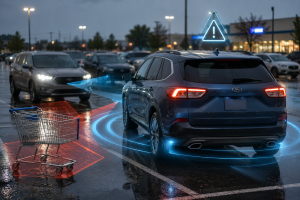
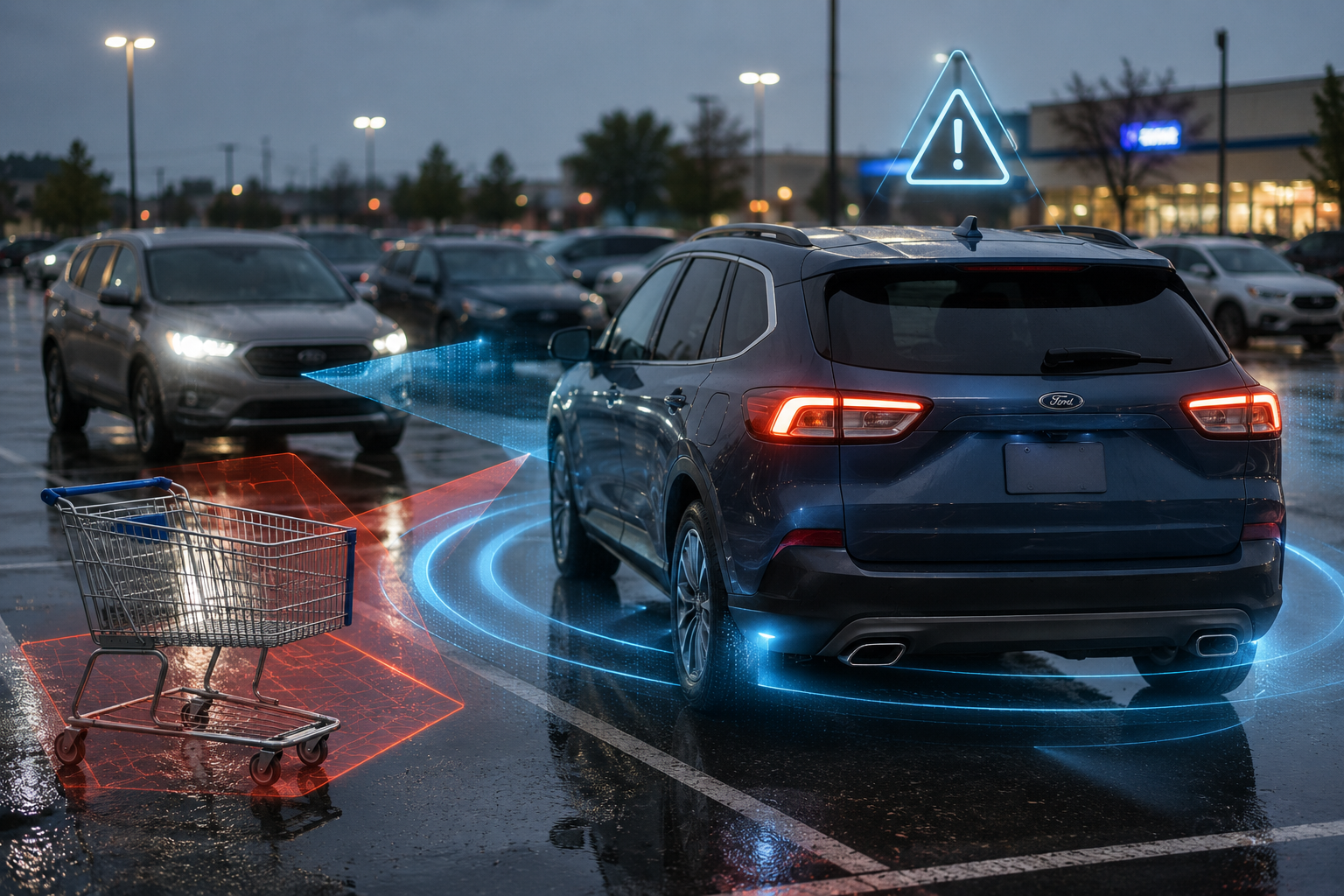
Ford recently filed a patent called “System for Detecting Moving Objects.” The system focuses on protecting parked vehicles from incoming threats.
According to the patent description, the technology would use:
- Exterior cameras
- Sensors
- Software analysis systems
- Artificial intelligence tools
- Vehicle communication systems
The goal is simple: detect possible danger before impact happens.
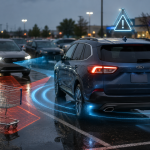
The system would continuously monitor the area around a parked vehicle. If it notices an object moving in a dangerous way, the software would analyze whether a collision is likely.
Possible threats could include:
- A car sliding on ice
- A driver losing control while parking
- A fast-moving vehicle entering the parking area
- A shopping cart rolling downhill
- Heavy equipment moving nearby
- A distracted driver reversing too quickly
If the system believes a crash may happen, it could respond in different stages.
How the System Could React to Danger
Ford’s patent describes multiple response levels depending on how serious the threat becomes.
Warning Signals
The first step would likely involve warning nearby people.
The vehicle could:
- Flash its lights
- Activate alarm sounds
- Use external speakers
- Send alerts to the owner’s smartphone
- Display warnings on connected apps
These alerts could help attract attention and possibly stop the dangerous situation before impact occurs.
For example, if another driver is reversing too quickly toward the parked car, warning lights or sounds may help them react in time.
Recording the Incident
The system may also activate onboard cameras to record the event.
This feature could provide:
- Video evidence for insurance claims
- Details about the accident
- Proof of responsibility
- Better analysis of vehicle damage
Many modern vehicles already include dashcams or security recording systems. Ford’s patent suggests combining these functions with active safety analysis.
Autonomous Movement
The most advanced part of the patent involves the possibility of the vehicle moving itself to avoid danger.
If the software determines that a collision is unavoidable unless the car changes position, the system could potentially:
- Reverse slightly
- Move forward
- Adjust steering angle
- Relocate to a safer parking spot
This feature would require extremely advanced control systems because the car must avoid hitting pedestrians, walls, or nearby vehicles while escaping danger.
Ford’s patent suggests that the vehicle would only move when conditions are considered safe.
Why This Technology Matters
At first glance, protecting parked cars may seem less important than highway safety systems. However, this technology could provide several major benefits.
Lower Repair Costs
Parking accidents create billions of dollars in repairs every year.
Avoiding even small collisions could save drivers:
- Insurance deductibles
- Repair bills
- Time at repair shops
- Reduced vehicle value
Modern vehicle repairs are especially expensive because bumpers now contain radar systems, parking sensors, cameras, and electronic modules.
Better Insurance Support
Recorded video footage could simplify insurance investigations.
Instead of arguing about responsibility, drivers could provide clear evidence showing exactly what happened.
This may reduce:
- Fraudulent claims
- Legal disputes
- Insurance processing time
- Administrative costs
Improved Urban Parking Safety
Cities continue growing more crowded every year.
Parking spaces are becoming tighter, while drivers face more distractions than ever before.
Smart protection systems may help reduce stress in crowded urban environments.
Increased Vehicle Security
A vehicle that constantly monitors its surroundings may also improve protection against vandalism, theft, or suspicious activity.
The same cameras and sensors used for collision prevention could potentially support advanced security features.
The Growing Importance of AI in Modern Cars
Ford’s patent highlights another important trend in the automotive industry: artificial intelligence.
Modern vehicles already use AI for:
- Voice assistants
- Navigation systems
- Driver monitoring
- Automatic braking
- Lane keeping
- Traffic sign recognition
- Adaptive cruise control
The new parking protection system would likely depend heavily on AI-based object recognition.
The software must quickly answer important questions:
- Is the object moving dangerously?
- What direction is it traveling?
- How fast is it approaching?
- Is a collision likely?
- Can the vehicle safely move away?
These decisions require extremely fast processing.
Unlike humans, AI systems can continuously monitor all directions at the same time without becoming distracted or tired.
How Sensors Help Modern Vehicles Understand Their Environment
Ford’s patent would rely on multiple types of sensors working together.
Cameras
Exterior cameras provide visual information about nearby objects.
They help identify:
- Vehicles
- Pedestrians
- Shopping carts
- Curbs
- Walls
- Parking lines
Camera systems continue improving thanks to better image quality and AI processing.
Radar Sensors
Radar helps measure distance and movement speed.
Unlike cameras, radar can often function better in:
- Rain
- Fog
- Snow
- Darkness
This makes radar important for reliable safety systems.
Ultrasonic Sensors
These sensors are already common in parking assistance systems.
They help detect nearby obstacles at short distances.
LiDAR Technology
Some future systems may also use LiDAR.
LiDAR creates detailed 3D maps of the environment using laser signals.
Although expensive, LiDAR can provide extremely accurate object detection.
Could Self-Moving Parked Cars Become Common?
The idea of parked vehicles moving themselves may sound futuristic, but the automotive industry is already moving in this direction.
Several companies are developing autonomous parking technologies.
Some modern systems already allow vehicles to:
- Park themselves automatically
- Exit parking spaces remotely
- Drive short distances without human input
- Follow drivers in parking areas
Ford’s concept expands this idea by allowing cars to react independently to danger.
In the future, vehicles may become active participants in protecting themselves.
Instead of passively waiting for impact, cars could constantly evaluate risk and respond intelligently.
Challenges Ford Must Solve
Although the patent sounds impressive, many technical and legal challenges remain.
Safety Concerns
A vehicle moving without a driver nearby creates important safety questions.
The system must guarantee that the car will not:
- Hit pedestrians
- Damage nearby property
- Cause traffic problems
- Create new risks while escaping danger
Even a small mistake could lead to serious consequences.
Legal Responsibility
If a self-moving parked car causes damage, who becomes responsible?
Possible parties could include:
- The vehicle owner
- The manufacturer
- The software developer
- Insurance companies
Governments will likely need new regulations for autonomous safety systems.
Sensor Accuracy
The technology must correctly distinguish between real danger and harmless movement.
For example:
- A person walking near the vehicle is normal.
- A cart rolling directly toward the car may be dangerous.
- Another vehicle parking slowly may not require emergency action.
False alarms could create frustration for drivers.
Battery Consumption
Constantly monitoring surroundings requires electrical power.
Ford would need to design the system carefully to avoid draining the vehicle battery while parked for long periods.
Why Patents Do Not Guarantee Production
It is important to understand that patents do not automatically mean a feature will appear in production vehicles.
Car manufacturers regularly patent experimental technologies.
Some ideas become successful products, while others never leave the research stage.
Companies file patents for several reasons:
- Protecting intellectual property
- Exploring future technologies
- Preventing competitors from copying ideas
- Testing possible innovations
- Preparing for future market demand
Ford itself has patented many concepts over the years that never reached dealerships.
However, even if this exact system never becomes reality, the patent still shows the direction of future automotive development.
How Other Automakers Are Developing Similar Technologies
Ford is not alone in exploring smart vehicle protection systems.
Many global automakers are investing heavily in autonomous safety features.
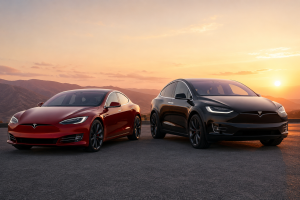
Tesla
entity[“company”,”Tesla”,”Automotive and energy company”] uses advanced camera systems and AI software for Autopilot and Full Self-Driving technologies.
Tesla vehicles already monitor surroundings constantly using multiple cameras.
Mercedes-Benz
entity[“company”,”Mercedes-Benz”,”German luxury automotive manufacturer”] offers advanced parking assistance systems in several premium models.
Some vehicles can automatically park and leave parking spaces with minimal driver input.
BMW
entity[“company”,”BMW”,”German automotive manufacturer”] has developed remote parking technologies that allow drivers to control parking functions using smartphones.
Hyundai
entity[“company”,”Hyundai Motor Company”,”South Korean automotive manufacturer”] introduced Smart Park systems capable of moving vehicles in and out of tight parking spots remotely.
These developments show that autonomous parking safety is becoming an important area for the entire industry.
Parking Lots Are Becoming More Dangerous
Modern parking areas may look simple, but they are surprisingly complex environments.
Drivers face many distractions, including:
- Smartphones
- Loud music
- GPS systems
- Crowded conditions
- Poor weather
- Stress
- Fatigue
Large SUVs and pickup trucks also create visibility problems.
Many vehicles now have higher front ends and larger blind spots than older cars.
At the same time, cities continue reducing parking space sizes to fit more vehicles into limited areas.
This combination increases accident risk.
According to road safety experts, low-speed collisions remain one of the most common forms of vehicle damage.
Smart safety systems may become increasingly necessary as urban areas grow denser.
Could This Technology Reduce Insurance Prices?
Insurance companies closely follow automotive safety innovations.
Features that reduce accidents often lead to lower insurance risk.
For example, many insurers already offer discounts for vehicles equipped with:
- Automatic emergency braking
- Anti-theft systems
- Lane departure warnings
- Dash cameras
- Advanced driver assistance systems
If Ford’s technology proves effective, insurance companies may eventually support vehicles with advanced parked-car protection.
However, insurers would first need strong data proving that the system reliably reduces claims.
The Role of Connected Cars
Modern vehicles are becoming increasingly connected.
Many new cars already communicate with:
- Smartphones
- Cloud servers
- Traffic systems
- Navigation services
- Emergency response networks
Ford’s future safety system could potentially use connected technology to improve decision-making.
For example, nearby vehicles might share information about dangerous conditions.
A connected parking lot may eventually allow vehicles to cooperate automatically.
Cars could warn each other about:
- Slippery surfaces
- Fast-moving vehicles
- Obstacles
- Pedestrians
- Unsafe parking behavior
This type of communication could dramatically improve parking safety.
Why Drivers Care About Parking Damage
Many people underestimate the emotional impact of parking accidents.
Drivers often feel frustrated when returning to a damaged car.
Common problems include:
- Scratched paint
- Bent bumpers
- Broken mirrors
- Dented doors
- Cracked lights
Even when damage seems minor, repairs may take days or weeks.
Drivers must deal with:
- Insurance paperwork
- Repair appointments
- Transportation problems
- Financial stress
Technology that prevents these situations could improve the ownership experience significantly.
Could Electric Vehicles Benefit Even More?
Electric vehicles may benefit strongly from advanced parking protection systems.
EV repairs are often especially expensive because many components are integrated into complex electronic structures.
Battery systems also require careful protection.
Manufacturers want to reduce any risk of:
- Battery damage
- Sensor misalignment
- Structural impact
- Software failures
Since EVs already rely heavily on advanced software, integrating intelligent parking protection may become easier in future electric platforms.
Ford’s expanding EV lineup could potentially support these technologies more effectively than older mechanical vehicle designs.
How Autonomous Technology Is Expanding Beyond Driving
For years, autonomous vehicle discussions focused mainly on highway driving.
Now, manufacturers are exploring many other applications.
Future vehicles may eventually handle:
- Parking
- Charging
- Vehicle maintenance scheduling
- Security monitoring
- Emergency response
- Traffic communication
- Collision prevention while stationary
Cars are gradually becoming mobile computing systems rather than simple transportation machines.
Ford’s patent fits directly into this broader transformation.
Potential Privacy Concerns
Continuous camera monitoring may also raise privacy concerns.
Some people worry about:
- Constant video recording
- Data storage practices
- Remote access to footage
- Cybersecurity risks
- Personal privacy in public spaces
Automakers must carefully balance safety benefits with responsible data protection.
Governments may eventually require strict rules regarding:
- Data collection
- Storage duration
- User consent
- Security standards
- Third-party access
Cybersecurity will become especially important as vehicles gain more autonomous capabilities.
Could Parking Lots Become Smarter Too?
Ford’s patent may represent only one part of a larger future ecosystem.
Smart parking lots could eventually include:
- Connected sensors
- Vehicle communication systems
- AI traffic monitoring
- Automatic parking guidance
- Collision prevention networks
Instead of individual vehicles acting alone, entire parking environments may become intelligent.
For example, a smart parking system might detect a dangerous sliding vehicle and warn nearby cars instantly.
This could create a coordinated safety network.
The Evolution of Parking Technology
Parking systems have changed dramatically over the past decades.
Early Parking Assistance
The first parking aids were very simple.
Drivers mainly relied on:
- Mirrors
- Basic distance judgment
- Manual steering skills
Parking Sensors
Later, ultrasonic parking sensors became popular.
These systems used sound waves to detect nearby obstacles.
Rear Cameras
Backup cameras improved visibility significantly.
Many countries now require rear cameras in new vehicles.
Automatic Parking
Modern cars can now steer themselves into parking spaces.
Some systems control:
- Steering
- Acceleration
- Braking
- Gear shifting
Predictive Protection
Ford’s patent represents the next step: predictive parking safety.
Instead of reacting after danger appears, the vehicle would attempt to predict and avoid impact before it happens.
Why AI Is Especially Useful in Parking Situations
Parking environments are unpredictable.
Unlike highways, parking lots contain:
- Random movement
- Pedestrians
- Tight spaces
- Multiple directions of travel
- Frequent stopping
- Unexpected obstacles
Human drivers may miss small details when distracted or tired.
AI systems can process enormous amounts of information continuously.
Advanced machine learning models can recognize patterns associated with dangerous behavior.
For example, the software may learn to identify:
- A vehicle approaching too quickly
- Wheels sliding sideways on ice
- Sudden steering corrections
- Erratic reversing behavior
These patterns may help predict collisions before humans notice danger.
Could This Technology Help Commercial Fleets?
Fleet operators spend huge amounts of money repairing vehicles.
Delivery companies, rental businesses, and logistics operators often manage thousands of vehicles.
Parking damage creates:
- Repair expenses
- Vehicle downtime
- Insurance costs
- Operational delays
An advanced protection system could help fleets reduce these problems.
Commercial applications may become especially attractive because even small reductions in damage rates could save companies millions of dollars.
The Competitive Race for Smarter Cars
The automotive industry is experiencing intense competition in software and AI development.
In the past, automakers mainly competed through:
- Engine performance
- Design
- Fuel economy
- Reliability
Today, software innovation is becoming equally important.
Consumers increasingly expect:
- Smart safety features
- Connected services
- Autonomous functions
- Smartphone integration
- AI assistance
Companies that lead in intelligent vehicle systems may gain major competitive advantages.
Ford’s patent suggests the company wants to remain active in this rapidly evolving market.
Real-World Situations Where the System Could Help
To understand the value of the technology, it helps to imagine practical scenarios.
Scenario 1: Slippery Winter Parking Lot
A driver loses control on icy pavement while entering a parking area.
Ford’s system detects abnormal movement and predicts possible impact.
The parked vehicle activates warning lights and slightly changes position to avoid collision.
Scenario 2: Distracted Driver
A driver reverses while looking at a smartphone.
The system recognizes the approaching vehicle and issues audible warnings.
The distracted driver notices the alert and stops in time.
Scenario 3: Rolling Shopping Cart
Strong wind pushes a shopping cart downhill.
Sensors track the cart’s direction and speed.
The vehicle records the incident and warns nearby people.
Scenario 4: Tight Urban Parking
A driver attempts difficult parallel parking in a crowded city.
The parked vehicle predicts incorrect maneuvering and moves slightly forward to increase safe distance.
These examples show how predictive safety could reduce everyday stress.
The Cost of Modern Vehicle Repairs
One reason automakers focus heavily on collision prevention is the rising cost of repairs.
Modern cars contain sophisticated technology inside exterior components.
A front bumper may include:
- Radar sensors
- Cameras
- Wiring systems
- Airflow sensors
- Parking electronics
Even small impacts may require:
- Sensor recalibration
- Computer diagnostics
- Software updates
- Expensive replacement parts
Luxury vehicles often cost even more to repair.
As automotive technology grows more advanced, preventing accidents becomes financially more valuable.
Could Autonomous Parking Become Mandatory?
Governments around the world continue strengthening vehicle safety regulations.
Many safety technologies once considered optional are now mandatory in several countries.
Examples include:
- Seat belts
- Airbags
- Backup cameras
- Electronic stability control
- Automatic emergency braking in some markets
If predictive parking protection proves highly effective, regulators may eventually encourage similar systems.
However, this would likely take many years.
Why Drivers Trust Technology More Slowly Than Expected
Although automotive AI continues improving, many drivers remain cautious about autonomous features.
Common concerns include:
- Software errors
- Technical failures
- Unexpected behavior
- Cybersecurity risks
- Loss of driver control
Ford and other manufacturers must build strong public trust before advanced self-moving systems become mainstream.
Clear safety testing and transparent communication will be essential.
How Ford Has Invested in Advanced Technology
The company has explored:
- Electric vehicles
- Autonomous driving
- AI software
- Connected car services
- Smart mobility systems
Ford has also partnered with technology companies to strengthen software development capabilities.
The parking protection patent reflects Ford’s broader interest in intelligent vehicle ecosystems.
The Difference Between Active and Passive Safety
Traditional vehicle safety systems are usually divided into two categories.
Passive Safety
Passive systems protect occupants after an accident happens.
Examples include:
- Seat belts
- Airbags
- Crumple zones
- Reinforced structures
Active Safety
Active systems try to prevent accidents before they occur.
Examples include:
- ABS braking
- Stability control
- Lane assist
- Automatic emergency braking
Ford’s new patent belongs to active safety because the goal is collision prevention.
Interestingly, it focuses on protecting stationary vehicles rather than moving ones.
Could Future Cars Become Fully Self-Protecting?
Ford’s concept raises an interesting possibility.
Future vehicles may eventually become highly independent systems capable of protecting themselves automatically.
Cars could potentially:
- Avoid collisions
- Move away from dangerous weather
- Relocate during flooding risks
- Seek charging stations automatically
- Contact emergency services after incidents
This would represent a major shift in how humans interact with vehicles.
Cars would no longer simply wait for instructions from drivers.
Instead, they could make limited safety decisions independently.
The Importance of Reliable Software Testing
Advanced safety systems require extremely careful testing.
Software errors in autonomous systems can create serious risks.
Manufacturers must test vehicles under many conditions:
- Rain
- Snow
- Fog
- Darkness
- Crowded parking lots
- Different road surfaces
- Various obstacle types
The software must also react correctly to unusual situations.
Real-world environments are unpredictable.
A system that works perfectly in one scenario may fail in another unless thoroughly tested.
Could Artificial Intelligence Reduce Human Error?
Human error remains one of the biggest causes of accidents.
Drivers become distracted by:
- Phones
- Passengers
- Fatigue
- Stress
- Multitasking
AI systems do not experience tiredness or emotional distraction.
Although technology is not perfect, advanced automation may eventually reduce many low-speed parking accidents caused by human mistakes.
However, experts also warn that drivers must avoid becoming too dependent on technology.
Human supervision remains important.
The Future of Vehicle Ownership Experience
Car buyers increasingly expect more than transportation.
Modern consumers value:
- Convenience
- Smart technology
- Digital services
- Advanced safety
- Reduced stress
Features that protect parked vehicles may improve overall customer satisfaction.
Drivers often spend large amounts of money maintaining their vehicles.
Technology that prevents damage can protect both financial investment and peace of mind.
Could This Technology Work in Underground Parking Garages?
Underground parking garages present unique challenges.
Conditions often include:
- Poor lighting
- Tight spaces
- Concrete pillars
- Limited visibility
- Echoing sound environments
Advanced sensors would need to function reliably in these conditions.
Combining multiple sensor types could improve accuracy.
For example:
- Cameras provide visual detail
- Radar measures movement
- Ultrasonic sensors help at close range
This layered approach is common in modern autonomous systems.
Environmental Conditions Create Extra Challenges
Weather significantly affects parking safety.
Snow, rain, fog, and ice can reduce:
- Visibility
- Tire traction
- Sensor performance
- Driver reaction time
Ford’s future system would need strong environmental adaptation.
Reliable operation during bad weather is critical because many parking accidents occur under difficult conditions.
Could Smart Cars Communicate With Emergency Services?
Future intelligent safety systems may eventually connect directly with emergency response networks.
If a serious impact becomes unavoidable, vehicles could automatically:
- Record incident data
- Contact emergency services
- Share GPS location
- Notify owners
- Provide video evidence
Connected vehicle ecosystems may dramatically improve accident response efficiency.
The Economics Behind Automotive Innovation
Developing advanced safety technology requires enormous investment.
Manufacturers spend billions on:
- Software engineering
- Sensor research
- AI development
- Safety testing
- Cybersecurity
- Manufacturing integration
Why do companies invest so heavily?
Because consumers increasingly choose vehicles based on technology features.
Safety innovation also helps manufacturers strengthen brand reputation.
Companies associated with advanced safety often gain stronger customer trust.
Why Parking Safety May Matter More in the EV Era
Electric vehicles are often heavier than traditional cars because of large battery packs.
This increases the importance of avoiding even low-speed impacts.
Battery damage can become extremely expensive and potentially dangerous.
Protective technologies may therefore become especially important for future EV fleets.
As more vehicles become software-defined platforms, intelligent safety features may spread rapidly.
Public Reaction to Autonomous Features
Public opinion about autonomous technology remains divided.
Some drivers are excited about:
- Convenience
- Reduced stress
- Improved safety
- Smart automation
Others worry about:
- Software reliability
- Hacking risks
- Loss of human control
- High repair costs
Manufacturers must balance innovation with simplicity and trust.
Clear user education will also be necessary.
Drivers need to understand exactly what the technology can and cannot do.
Could This Technology Increase Vehicle Prices?
Advanced sensors and AI systems are expensive.
If Ford eventually introduces this feature, it may first appear in premium models.
Over time, costs usually decrease as technology becomes more common.
This pattern already happened with:
- Backup cameras
- Parking sensors
- Adaptive cruise control
- Blind spot monitoring
Eventually, features once considered luxury options often become standard equipment.
The Importance of Software Updates
Modern vehicles increasingly rely on software updates.
Future parking safety systems may improve continuously through:
- AI learning improvements
- Better object recognition
- Bug fixes
- New safety algorithms
Over-the-air updates already allow some manufacturers to improve vehicle capabilities remotely.
This means cars may become smarter throughout their lifespan.
How Smart Parking Could Affect Urban Design
If autonomous parking systems become common, city infrastructure may eventually change too.
Future parking areas could include:
- Dedicated autonomous movement lanes
- Sensor-equipped spaces
- Vehicle communication networks
- AI-controlled traffic flow
Urban planners may redesign parking environments around intelligent vehicles.
This could improve:
- Safety
- Space efficiency
- Traffic flow
- Convenience
Why the Patent Is Still Important Even Without Production
Some people dismiss patents because many never become commercial products.
However, patents still provide valuable insight into industry direction.
They reveal:
- Research priorities
- Emerging trends
- Technological possibilities
- Long-term company strategy
Ford’s patent clearly shows that manufacturers are thinking beyond traditional driving safety.
The future of automotive protection may involve vehicles capable of monitoring and defending themselves even while parked.
What Experts May Watch Next
Industry analysts will likely monitor several developments closely.
Important questions include:
- Will Ford demonstrate a working prototype?
- Can the system operate safely in crowded environments?
- How accurate is the threat prediction?
- What regulations may apply?
- Will insurance companies support the technology?
The answers will determine whether predictive parking protection becomes mainstream.
Could AI Eventually Predict Human Driving Mistakes?
One of the most interesting possibilities involves predictive behavioral analysis.
Advanced AI may eventually recognize patterns linked to dangerous driver behavior before accidents happen.
For example:
- Sudden acceleration
- Erratic steering
- Poor alignment while parking
- Excessive reversing speed
The vehicle could react before the driver fully loses control.
This represents a major shift from reactive safety toward predictive safety.
How Automotive Technology Continues Evolving
The automotive industry is changing faster than ever before.
Vehicles are becoming:
- More connected
- More automated
- More software-driven
- More intelligent
Features that once seemed impossible are now common.
Twenty years ago, many drivers considered backup cameras futuristic.
Today, they are normal equipment.
The same may eventually happen with predictive parking protection.
Final Thoughts
Ford’s new patent for a parked vehicle protection system offers a fascinating look into the future of automotive safety.
The concept combines cameras, sensors, AI software, and autonomous movement to help vehicles detect danger and potentially avoid collisions while parked.
Although the technology is still experimental, it highlights several important trends shaping the automotive industry:
- Growing use of artificial intelligence
- Expansion of autonomous vehicle functions
- Increased focus on predictive safety
- Rising importance of connected systems
- Demand for smarter parking solutions
Parking lot accidents may seem minor compared to highway crashes, but they create huge financial and emotional costs for drivers every year.
If systems like Ford’s eventually become reality, vehicles may gain the ability to actively protect themselves instead of waiting passively for damage.
For now, the patent remains a concept rather than a confirmed production feature. Still, it demonstrates how rapidly automotive technology continues evolving.
The future car may not only drive itself more safely — it may also know how to protect itself even when nobody is behind the wheel.