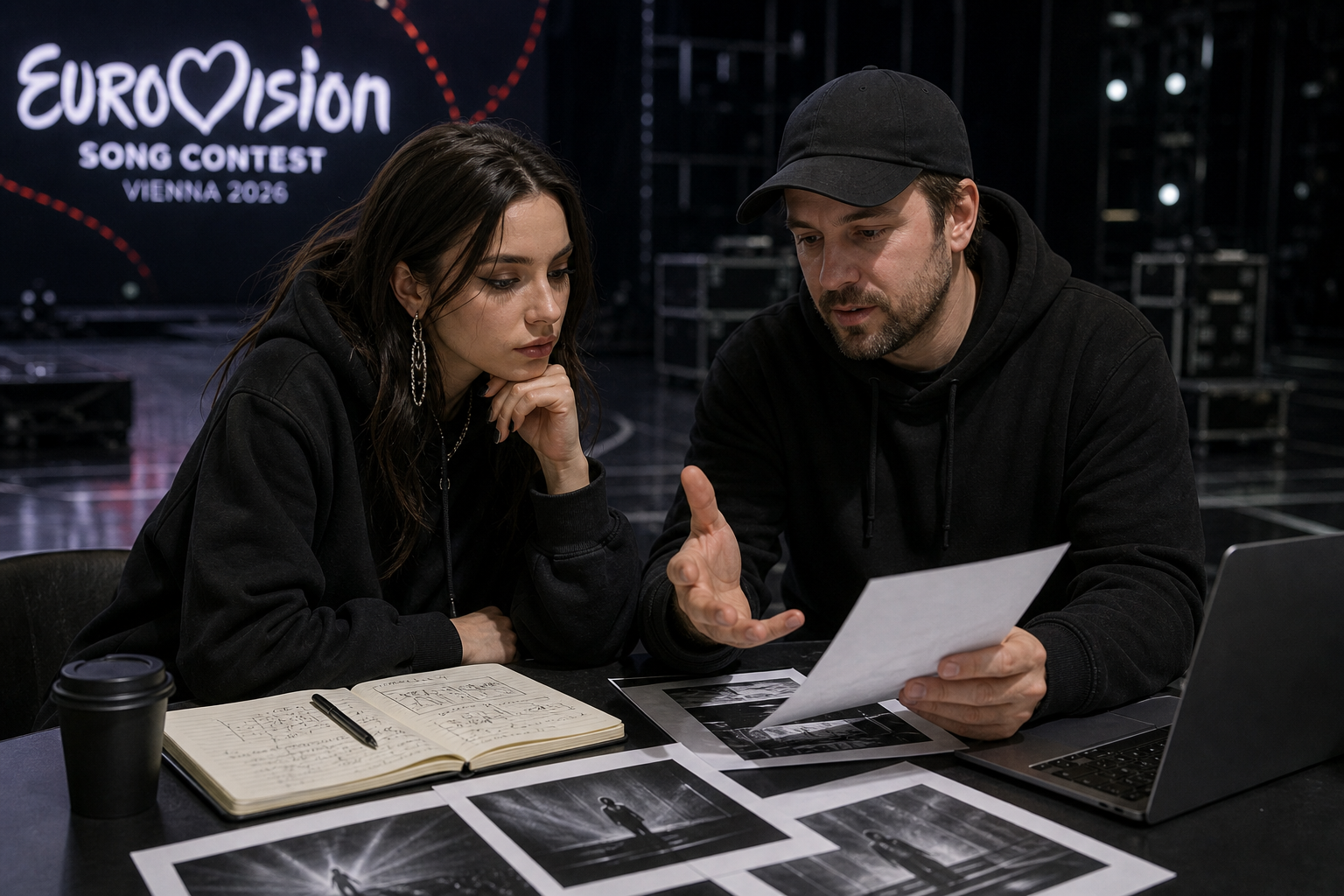
At first glance, this looks like a typical Eurovision update: a singer announces the creative team behind her performance. But when LELÉKA revealed that Illia Dutsyk will direct her staging for the Eurovision Song Contest 2026, the news carried a deeper meaning.
This is not just about one performance.
It is about a shift in style, in storytelling, and in how Ukraine presents itself on one of the biggest stages in the world.
More Than Just a Performance
Eurovision has always been more than music. It is a space where countries tell stories about identity, culture, and emotion through performance.
For Ukraine, this stage has become especially important.
From powerful political messages to deeply personal songs, the country has built a reputation for meaningful and memorable acts. That is why every creative decision matters — including the choice of director.
By selecting Illia Dutsyk, the team is clearly looking forward, not backward.
Who Is Illia Dutsyk?
Unlike many Eurovision directors who already have experience with large TV productions, Illia Dutsyk represents a new wave of creators.
He comes from the world of:
- music videos
- experimental visuals
- documentary storytelling
He has worked with artists such as Ziferblat, Dantes, and Katarina Gryvul. These collaborations are known for their strong visual identity and emotional depth.
But this project is different.
The Eurovision Song Contest stage is not just about aesthetics — it is about connection with millions of viewers in just three minutes.
For Dutsyk, this is both a challenge and an opportunity.
The Idea: From Fragmentation to Unity
The concept of the performance is built around a simple but powerful idea:
movement from fragmentation to unity
This is not just a visual concept. It reflects a psychological and emotional journey.
According to Illia Dutsyk, the performance explores:
- inner conflict
- identity
- the process of becoming whole
The key emotion is hope.
This makes the performance feel both personal and universal — something that many viewers across Europe can relate to.
Trust as the Foundation
For LELÉKA, choosing the right director was not just a professional decision. It was emotional.
She emphasized that she needed someone who truly understands the song Ridnym.
That connection became the foundation of the project.
Instead of a traditional “artist + director” relationship, this collaboration feels more like a shared creative process.
This matters, because Eurovision performances often fail when they look impressive but feel empty.
Here, the goal is the opposite.
The Role of Movement
Another important part of the performance is physical expression.
Halyna Pekha joined the team to work on movement and stage presence.
Her role includes:
- shaping body language
- translating emotions into motion
- building a visual rhythm for the performance
This suggests that the act will not rely only on vocals or visuals, but on the full physical presence of the artist.
In modern Eurovision, this is becoming more and more important.
A Visual Language for a Digital Era
One of the biggest challenges for Eurovision today is attention.
Viewers no longer watch performances in silence. They scroll, comment, and react in real time.
This changes how performances are designed.
A successful act must work on multiple levels:
- live audience
- TV broadcast
- social media clips
The team behind LELÉKA seems aware of this.
By combining emotional storytelling with strong visuals and movement, they are creating something that can live beyond the stage.
The Vienna Context
The Eurovision Song Contest 2026 will take place in Vienna, a city known for its musical history.
This is also a special year — the 70th anniversary of the contest.
The event will be hosted there after the victory of JJ with the song Wasted Love.
Important dates:
- May 12 – first semi-final
- May 14 – second semi-final
- May 16 – grand final
Ukraine will perform in the second half of the second semi-final — a position that often helps artists stay memorable.
A Changing Eurovision
To understand why this creative direction matters, we need to look at how Eurovision is changing.
In the past, success often depended on:
- big vocals
- dramatic staging
- clear visual hooks
Today, the competition is more complex.
Audiences expect:
- authenticity
- emotional depth
- originality
Performances that feel “too produced” can fail, even if they look perfect.
This creates space for new voices like Illia Dutsyk.
Ukraine’s Creative Strategy
Ukraine has been one of the most successful countries in recent Eurovision history.
Its entries often combine:
- cultural identity
- modern production
- strong visual storytelling
By choosing a director from a new generation, Ukraine is continuing this strategy.
But there is also a risk.
New voices bring fresh ideas but they also bring uncertainty.
The Risk and the Opportunity
Every Eurovision performance is a balance between risk and control.
Too safe – and the audience forgets you.
Too experimental – and the audience does not understand you.
The collaboration between LELÉKA and Illia Dutsyk sits exactly in this space.
If it works, it could become one of the most memorable acts of the year.
If it fails, it may feel too abstract for a mainstream audience.
Emotional Storytelling as a Strategy
One thing is clear: this performance is built on emotion.
Instead of focusing only on spectacle, the team is trying to create:
- connection
- empathy
- recognition
This reflects a broader trend in Eurovision, where the most successful acts often feel personal.
What to Expect on Stage
While many details are still unknown, we can expect:
- symbolic visuals
- meaningful movement
- a clear emotional arc
The presence of props and special effects suggests that the performance will have strong visual moments – but they will likely support the story, not replace it.
Beyond Eurovision
Regardless of the result, this project is important for another reason.
It shows how Ukrainian artists are evolving.
They are:
- experimenting with new formats
- collaborating across disciplines
- building a modern creative identity
In this sense, the performance is not just about competition.
It is about direction.
Final Thought: A Performance About Becoming Whole
At its core, this story is simple.
A singer and a director are working together to create a performance.
But the meaning is deeper.
It is about:
- finding connection
- building trust
- turning emotion into art
The real question is not just whether LELÉKA will succeed at the Eurovision Song Contest 2026.
The real question is:
Will this performance make people feel something real?
Because in the end, that is what Eurovision remembers.